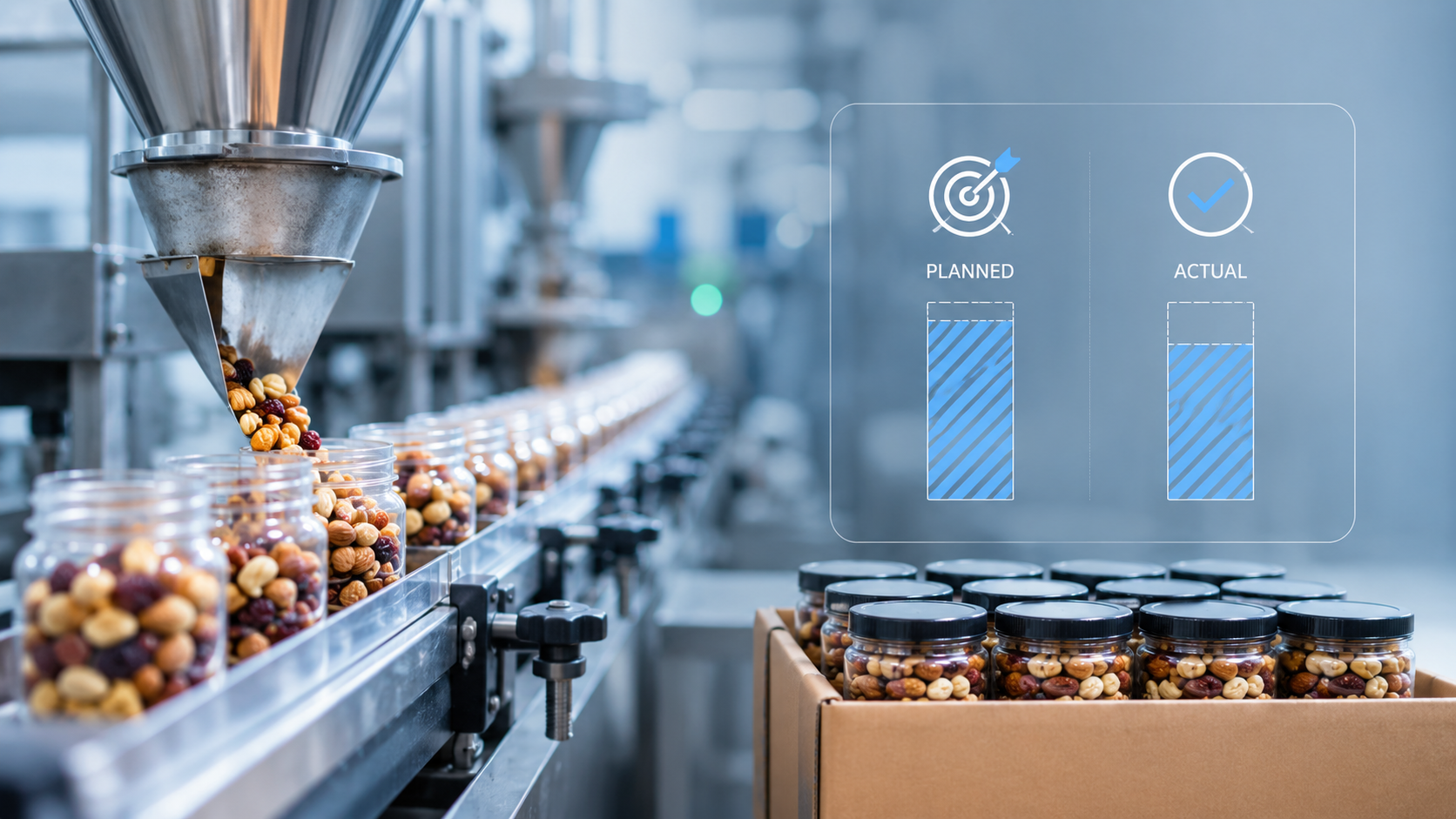
You bought the right amount of material. You followed the bill of materials or recipe. Production completed the batch.
But you didn't get the quantity of finished product you expected.
For manufacturers using QuickBooks Online, QuickBooks Desktop, Sage 50, Sage 300, or Sage Intacct, that can create an important question:
Where did the difference go, and what did it actually cost us?
This is especially common in food, chemical, cosmetics, pharmaceutical, plastics, and other process-oriented manufacturing environments where the same recipe does not always produce exactly the same quantity of finished product.
It is called variable yield.
What Is Variable Yield in Manufacturing?
A bill of materials or manufacturing recipe normally defines how much material should be required to produce a specific quantity of finished product.
For example:
- 500 pounds of ingredients
- Expected finished quantity: 1,000 units
If production consumes the 500 pounds of ingredients but only produces 900 acceptable finished units, the manufacturing process produced less than expected.
The operation is 100 units short of its expected yield.
And those missing 100 units matter.
The ingredients were still purchased. The material was still consumed. Production still used equipment, labor, and manufacturing time.
Instead of spreading those costs across 1,000 finished units, you now have only 900 finished units available to absorb them.
That can make the actual cost of each sellable unit higher than expected.
Why Does Manufacturing Yield Change?
Variable yield does not necessarily mean someone made a mistake.
In many manufacturing environments, some amount of variation is normal.
Material Loss
Spillage, evaporation, residue left inside processing equipment, trimming, and handling losses can reduce the amount of finished product produced from a batch.
Environmental Conditions
Temperature, humidity, atmospheric pressure, and other environmental factors can change the way ingredients or materials behave during production.
Raw Material Differences
The same material purchased from two suppliers may meet specification but behave differently during manufacturing.
Variations in moisture content, density, viscosity, concentration, or other characteristics can affect actual output.
Material Substitutions
Manufacturers occasionally substitute materials because of availability, lead times, or cost.
A substitute may meet the basic requirements of the product while producing a slightly different manufacturing yield.
Production Process Differences
Equipment settings, processing time, operator technique, and production procedures can also affect the amount of usable finished product produced.
The important question isn't whether variation ever occurs.
It's whether you can see it, measure it, and understand what it is doing to your costs.
Variable Yield Can Quietly Affect Your Gross Margin
Consider a simplified example.
A manufacturer expects a production batch to create 1,000 finished units.
The material consumed by the batch costs $2,000.
At the expected yield:
$2,000 / 1,000 units = $2.00 material cost per unit
But suppose the actual production quantity is only 900 units.
The same $2,000 of material was consumed.
Now:
$2,000 / 900 units = $2.22 material cost per unit
Your material cost per usable unit increased by approximately 11%.
And that is before considering labor, overhead, scrap, or other production costs.
If your selling price was established using the expected cost of production, repeated yield losses can gradually eat into gross margin without being immediately obvious from the accounting system alone.
Why QuickBooks or Sage May Not Tell You the Whole Story
QuickBooks and Sage are excellent accounting systems.
They can tell you what you purchased, what you paid suppliers, what you sold, what customers owe you, and what ultimately reaches the General Ledger.
But manufacturing creates another layer of activity between purchasing raw materials and selling finished goods.
Manufacturers also need to know:
- What raw materials were consumed?
- What material is currently in Work in Process?
- What should a production run have produced?
- What did it actually produce?
- What did that production run actually cost?
- Are production costs consistently running above expectations?
- Are yield problems isolated or becoming a trend?
That is manufacturing information, not simply accounting information.
MISys Manufacturing is designed to manage that manufacturing layer while allowing you to continue using your existing QuickBooks or Sage accounting software.
Tracking Actual Production with MISys Manufacturing
In MISys Manufacturing, the bill of materials defines the components required to manufacture an item.
For manufacturers using batch or process-style production, those components may represent ingredients measured in pounds, gallons, ounces, kilograms, or other units.
The BOM establishes the expected relationship between the materials consumed and the finished item being produced.
When production is processed through MISys, raw materials and Work in Process can be tracked separately from finished inventory.
With Manufacturing Orders, the actual quantity completed can be recorded rather than assuming that every production run produced exactly what the BOM predicted.
That distinction matters.
If a production order expected 1,000 units but only 900 acceptable units were actually completed, MISys can record the 900 units that were really produced.
You do not have to pretend the other 100 exist simply because that was the original production plan.
Connecting the Production Difference to Accounting
MISys maintains a manufacturing subledger that records the accounting impact of manufacturing activity.
During assembly, MISys tracks the value moving through the manufacturing process. When the value of the finished assembly differs from the value expected from the manufacturing transaction, the difference can be recorded through the Assembly Variance accounting control.
The appropriate General Ledger account is determined by the accounting configuration and Account Sets established in MISys.
When Period End is processed, MISys transfers the applicable manufacturing debit and credit entries into the connected QuickBooks or Sage General Ledger.
This gives the accounting team the financial information it needs without requiring production personnel to manage manufacturing activity directly inside the accounting system.
Don't Just Account for Yield Variance. Learn From It.
Capturing the financial impact is important.
Understanding why it keeps happening is even more valuable.
If actual output regularly differs from expected output, management can begin asking better questions:
- Is our expected yield realistic?
- Has a raw material changed?
- Is one supplier producing better yield than another?
- Is excessive material being lost during handling?
- Has equipment performance changed?
- Is a particular production process generating unusual losses?
- Are certain products consistently more expensive to manufacture than their standard cost suggests?
- Should pricing be adjusted?
- Should the BOM or production standard be updated?
What initially looks like a small production variance can reveal a much larger purchasing, production, quality, or profitability issue.
Variable Yield Also Affects Production Planning
Yield isn't only an accounting problem.
It can become an inventory and customer-service problem.
Suppose you need 1,000 units to fill an order.
If your BOM says a production run yields 1,000 units but your actual historical yield averages only 94%, repeatedly planning production based on the theoretical quantity may leave you short.
For make-to-order manufacturers, that could mean discovering at the end of production that there isn't enough finished product to fill the customer's order.
For make-to-stock manufacturers, it can gradually reduce available inventory and contribute to unexpected shortages.
Tracking actual production results gives planners better information for deciding whether production quantities, safety stock, or manufacturing standards need to change.
Watch the Trend, Not Just One Batch
One unusual batch may not mean anything.
A repeated pattern does.
MISys provides reporting that can help manufacturers review manufacturing variances and investigate differences between expected and actual production performance.
MISys Alerts can also be configured to monitor manufacturing information and automatically notify the people responsible when predefined conditions occur.
Instead of discovering a recurring cost problem weeks later while reviewing financial statements, production and management teams can identify unusual activity closer to when it happens.
Keep QuickBooks or Sage. Add the Manufacturing Detail You're Missing.
Moving beyond spreadsheets or basic inventory tracking does not necessarily mean replacing the accounting system your company already knows.
MISys Manufacturing integrates with QuickBooks Online, QuickBooks Desktop, Sage 50 US, Sage 50 Canada, Sage 300, and Sage Intacct.
Your accounting software can continue managing the financial side of your business.
MISys adds the manufacturing capabilities needed to manage:
- Raw material inventory
- Work in Process
- Bills of material
- Production orders
- Material requirements
- Purchasing
- Production scheduling
- Manufacturing costs
- Production variances
Because knowing what you spent is important.
Knowing why manufacturing cost more than you expected is where you can begin doing something about it.